Tuesday, December 20, 2005

Kaalalli chakra!

That’s Kannada for ‘wheels on my feet’ cause I’m off again. Dehradun this time on a week-long birding trip with BSAP (Birdwatchers’ Society of Andhra Pradesh). I’ve just printed out the checklist and it runs into 13 pages and 402 species. Goody!

We’re a biggish group of 30 persons and it should be terrific, but do you realise what this opens up the possibilities of, people? Snow! Yes, S-N-O-W! I’m so excited and also a little worried that it might not actually snow while we’re there. Now this might seem absurd to those of you who’re quite used to it – in fact, I have a cousin now in Albany, USA, who’s utterly depressed by the white around her – but I’ve never seen snow. Well, only in a there-yonder-on-the-mountain-peak kinda way but never touched it, never been snowed upon as in snowflakes on my nose and eyelashes. Cross my fingers and we shall see.

Back in 10 days. In the meantime, Happy Christmas everyone, and Happy New Year.

Friday, December 16, 2005

Bidar Diary

Plenty, plenty to see in Bidar: the town is strewn with monuments. Surprisingly, these don't make big news in the travel books and websites. When they spoke of the Bidar fort, so lacklustre was the advance publicity, I quite thought it would turn out to be some set of paltry ruins. Nothing of the sort! 5.5 km of defensive walls, 37 bastions, 7 gates, dozens of palaces and gardens, in reasonably good repair. Then there is the Mahmud Gawan Madrassa, a medieval dormitory for scholars; the Barid Shahi tombs and the Bahmani tombs at Ashtur.
But Bidar is rather unequipped to live off its treasures. Autowallahs know little or nothing about their own history and worse, are unwilling to ply to the remoter areas. The one we engaged for a morning actually brought us back into town without taking us to the Ashtur tombs at all. We demanded an explanation and got it: apparently, 'wahan koi nahi jaata'.
'The Barid Shahi tombs, next to the bus station?' we asked. No one knew. 'Just take us to the bus station', we said. There the tombs were in the background, with only a kaccha road leading to them. Not a board or signpost, just a few lie-abouts and boys playing cricket within the broken down 16th century mosque. The whole town ambles around, careless and unconscious of history in its midst.
The last to rule Bidar were the Nizams of Hyderabad, and so after the republic was formed, its upkeep was given into the care of the Archaeological Survey of India, Hyderabad. The reorganisation of states didn't change that, and Bidar must've felt all the disadvantages of step-motherly treatment. It has recently been moved to ASI's Dharwar circle and already renovations are under way.

+++++

Folks in Bidar are very fond of bakery stuffs and there is an Iyengar bakery in every street. They're good and cheap as well - we tried to buy a bun and got six for five rupees. Come evening, men mill around for cakes, rolls and curry puffs, which are served on recycled newspaper. Paint in a ubiquitous stray dog sitting by, gaze unwaveringly on the nearest food item and you have the picture.
Remember we'd also said the population was mostly Muslim, so how come there are so many Iyengar bakeries? The full names supply the rest of the story - in fact, Hassan Iyengar Bakery and Khan Iyengar Bakery.

+++++++++

There's a famous Narasimha temple in Bidar. It's in a cave and the way to the deity is a little arduous - devotees are required to wade through water to get to the sanctum.
This shrine is supposed to be pretty munificent, even removing problems such as the Saade Saathi (which would have been dead useful about now). 'How deep?' I enquired, 'paani gardan tak aata kya?'. The 6-footer I was questioning shook his head reassuringly, tapped his chest and said, 'Nai, nai, chaati talak aata.' Hmm.
I actually considered it, wading through this pond with water tickling my nostrils just for the adventure of it. Then again, it's supposed to be infested with cockroaches and mice (ewwwwww!) and I'm not that brave. Plus, little matter of clothes - not one of my garments was I willing to sacrifice to ickky muddy waters. So no go, I shall have to go through my karma the conventional way.

+++++++

I mentioned Bidri earlier? They use a zinc alloy as base metal, which is then inlaid with silver and blackened. The blackening process has a mystery attached - they use saltpeter and mud from the fort to make a bath. The finished piece is dunked in it and the mixture reacts chemically with the alloy. The effect is gorgeous - the zinc turns black, the silver doesn't. What it is that does the trick, no one knows.

Wednesday, December 14, 2005

Tour report

Been away on a longish weekend holiday, visiting Bidar. Shweta had a 15-day workshop to conduct, and it seemed like a good idea to go.

Bidar, if you’re interested in details of that sort, is in northern Karnataka, about 136 km from Hyderabad. Drought-prone, dry place with a majority Muslim population. Home to the Bidri craft – a lovely technique of silver inlay in blackened zinc. Also steeped in history. Used to be the seat of the Bahmani dynasty and later the Barid Shahis.

Lots to tell you about the place… but we got in last night after a jolty, harrowing bus ride; I have the runs thanks to a dinner made of the oiliest gobi manchuria I’ve had in a while and I cannot bring myself to describe the fort right now. So it’ll have to be slices over the next few days. Insha’allah.

Monday, December 05, 2005

Update

Hurrah for the power of the written word! I put down seven things I wanted to do, and here are quite a few done already!

Have I tidied up? Let me here proudly announce that all our CDs have been checked for contents, duly labelled and most importantly have been allotted CD covers, and put away for easy retreival. Yessssssssssss!

The printer has come. W/o scanner but we decided to go for a plain vanilla workhorse.

It is not quite the thing for freelancers to actually ask for a cessation of work. The gods, as we know, have a sense of humour and they might quite misunderstand the exact nature of the request, and then where would we be? Still, so frazzled was I with juggling deadlines that I made bold as to actually ask that of the universe. It has been granted me - a whole week of nothing to do. I have lingered on the lounge, with shawl draped around my feet and stirred as little as possible.

Er.. no.. I haven't actually made that list of books-to-read. Have decided to give up on that one - the books know when to find me.

Definitely found time for hair and skin care. No haglikeness. Tra la laaa.

Bought several clothes. More tra la la.

Two pairs of shoes. Ditto.

Now, if it was going to be this easy, why the hell didn't I reach higher?

Hanuman

I’ve been hollering Mahabali maharudra mahabhakta shauryavan veer Hanuman all of today. An after-effect of having watched Hanuman yesterday, the full length animation feature that has surprised everyone by becoming a moderate hit.

First, the soundtrack is great. Composer Tapas Relia uses traditional material and sets it nicely to fast paced, heart pumping rhythms that appeal. This particular number I mentioned has half the music industry singing it – Shaan, Sonu Nigam, Palash Sen, Kailash Kher, Madhushree, Sneha Pant and Sapna Mukherjee.

The movie has many pluses, not the least of which is the cutest baby Hanuman possible, cuddly, limpid wide eyes and all. There were a few minuses though. They can’t be very significant because kids seem to have loved it, and if they don’t form a discerning audience, who does? Also, animation seems like such an immense labour of love, I hesitate to sit back and point out flaws. I mean, people who attempt it in India are doing so in near-hostile circumstances; it seems like ingratitude to carp.

Having said that, it is because animation is such a laborious process that it becomes even more worthwhile to invest in the script. Hanuman is a fast paced story, but moves too hastily, and too episodically over the various heroic exploits on the director’s item list. I wasn’t entirely happy with the style of graphics but blame that entirely on years of reading Amar Chitra Kathas. Anything unlike those comics, and the mind rebels.

I also missed the depth of characterisation that would’ve uplifted the film. Remember that story about Hanuman sitting at the tip of the subcontinent, staring out at the ocean, struck immobile by an attack of insecurity, wondering if he could possibly leap it? That stirring speech by Jambavanta, reminding Hanuman of his powers, drawing out the self belief so necessary for such a stupendous feat. I like those parts of our mythology best - when the gods are a little human. The movie skims over most of these, but it was fun for all that.

PS. Is Hanuman really considered an avatar of Shiva? Mum says one thread of mythology does say that but this is the first I’ve heard of it.

Sunday, November 27, 2005

Ramses!

I love discovering authors; who doesn't? That joy however is amplified many times when I find they've slogged away diligently in all the years that I hadn't heard of their existence to create a nice long list of books. Once I've made sure they aren't going to jump something nasty or distressing on me, I like settling into comfortable friendships, understanding the shapes and textures of their worlds, investing in them, coasting where they take me. Comfort reading.

I like series and I tend to start with the very first one and track them as they develop. To observe how plots and characters develop of course, but equally the writer and the craft itself. Whether a book is honest to its own self-contained purpose while forming another link in a chain. To see how authors deal with more of the same, more of the different. To notice when they find their first wobbly feet, when they get into the stride, when they are most earnest, most practised, most formulaic, most true, most insightful.

I discovered Elizabeth Peters a couple of years ago. On our trip to Kodi, Sudha kept brandishing this paperback about - interesting cover and an even more intriguing title, Crocodile on the Sandbank. Quick scan of the blurb, and words leaped out: 1884, Egypt, tombs, archeologists, mystery. It sounded like fun.

Amelia Peabody, single and wealthy, travels to Egypt to see if it can offer her adventure. It does, of course, in the form of missing mummies and dastardly villains. It also offers her two enduring loves - archaeology and Radcliffe Emerson, 'the greatest Egyptologist of this or any other age.' That sets the tone for the series - they marry, have a son (whom they call Ramses) and return each year to Egypt to excavate sites and have thrilling encounters with arch enemy Sethos and other assorted bad men. There have been 17 books so far, I think.

Peters doesn't 'write' very well but she scores with characterisation, at least her primary characters. Brisk and managing, impetuous and brave, and with a robust sexual appetite, Amelia was amusing to begin with. But the books stayed superficial and a little into the series, I was quite ready to let go. Except they deepened.

Ramses grew up, and gently nudged his parents aside as he took centrestage. The precocious, verbose kid grows into a rather sexy young man, secretly and desperately in love with his adopted sister, Nefret. He has all the usual heroic attributes - intelligence, courage and oodles of sex appeal. He's taciturn, inscrutable, scrupulously polite, and astonishingly respectful of his overbearing parents. But Ramses is a vulnerable hero - a young man with very many fears, someone striving very hard to do the right thing.

He Shall Thunder in the Sky is set in troubled times, the beginning of WW I. The formula remains the same but the backdrop informs the narrative. Racism gets a look in, as do the sordidness of prostitution, and the senselessness of war.
Publicly reviled for not enlisting, Ramses is in fact a spy, albeit a reluctant one. Disguised as an Egyptian leader, he is shot one day and drags himself home in a near-faint. Amelia Peabody, who has hitherto treated her son with a mixture of exasperation and somewhat detached affection, learns what it means to her to have him at death's door.

Ramses's eyes opened. "I still hate this bloody war, you know," he said indistinctly.
"Then why are you doing this?"
His head moved restlessly on the pillow. "It isn't always easy to distinguish right from wrong, is it? More often the choice is between better and worse… and sometimes the line between them is as thin as a hair. One must make a choice, though. One can't wash one's hands and let others take the risks… including the risk of being wrong. There's always better… and worse… I'm not making much sense, am I?"
"It makes excellent sense to me," I said gently.

Including the risk of being wrong! I loved Ramses, and I suspect it was because I took the books at face value and he came up to surprise and move me. If you read these books and find you're beginning to like Ramses, don't start on Seeing a Large Cat without lining up The Falcon at the Portal, He Shall Thunder in the Sky and The Lord of the Silent. That way torture lies.

Friday, November 25, 2005

For Deepa

First, Happy Birthday - wishes are late but these ones last a year.
Second, but of course, babeh! I hereby tag Deepa to do the seven tag. What to do - you're so dignified, no one thinks you'd even consider doing all this seven-cheven chillarpana. Only, in your hands, it will not be chillar.

Tuesday, November 22, 2005

GoF

We are feeling bloggy! Why? It is due to eternal perversity of human nature. Because we cannot. Computer system is tottering on verge of collapse again. Internet on tap has trickled to not even a drip. We are seeing grainy dots on screen thanks to 16-color resolution and only erratic dial-up connectivity is being. Have not answered mails, have not read favourite bloggers, and not wished Happy Birthday to persons who having Happy Birthdays. Have had to consult reference books and look up dictionary books! That dire, it is being, situation. Naturally, just have to blog.

I am seeing HP and the GoF. Girl has made excellent points – need is not being to repeat. I am agreeing much. Also much approving point-wise format. Why create time wastage?
First, movie is being sometimes ok, sometimes so-so. Like good friend Samanth has said, problem is being with unwieldy book. What director and screenplay man can do – so much is there to tell. Still, I will tell you, it is not being stand-alone movie, it is only being supplementary material to books. But if you see in that way, it is being nice.

Thrilling scenes at Quidditch World Cup – amazing, stupendous, fabulous. Victor Krum is flying out and they are showing nicely his superstar status. I am having goose bumps – unfortunately there is being no match, no highlights even. Very diso. I am day dreaming much that someone will create/choreograph whole match and show us. Just like that. For fun.

They are showing too much of dragon, and also taking liberties with it. No no, do not let mind go to horrible places - I am only saying they are making dragon fly. Now, where it is written in books? They are showing very bad usage of Floo network, not understanding that head in fire must be at ninety degrees to logs, not lurk underneath charcoal. But castle, common room, library, owlery and all are lovely. Two-three looks are being exchanged by Krum and Hermione - new things, chemistry and such that was not there in books. I was thinking how different media must play to strengths; movie is also triggering thoughts like this.

Nice casting movie is having - I am loving bald head of Ralph Fiennes and also loooong fingers. V Sexy. Graveyard scenes are being bit scary.

Am not liking Mad Eye’s mad eye. Like high school drama prop, it is.

Parvati and Padma Patil!! Why why they are giving pretty girls clothes and jewellery like that? Horribly cut and stitched pink blouses with silly dupattas? Ghagra not too bad, but still compromise. Why cannot they order from India, when it is established that NRIs do tacky job of Indian clothes?

That is all.

Thursday, November 17, 2005

The seven tag

Been tagged by the Marauder to tell you random things about me in lists of seven.

Seven things I plan to do

Plans. I have pagefulls of them – vague, hopeful things. However, short term intentions also are being.

1. Tidy up, tidy up, tidy up.

2. Reclaim life – Get ALL deadlines out of the way, find a nice patch of sunlight, curl up and read.

3. Follow hair and skin care regimen and avert hag-likeness.

4. Get few decent posts up here. Sometime soon.

5. Get printer/scanner all-in-one thingy, absence of which has paralysed life for months.

6. Check out Bose showroom and be forever spoilt for lesser things.

7. Read all books that have been on shelf for months, even if have to make silly lists and determinedly go through, mood and inclination be damned.

Seven things I can't do

1. Have nice clothes tailored for me. Tailors totally intimidate me – honest, I can’t think of a single thing to say to them. So with the mother threatening to abandon me on grounds that I am now grown enough to organise my own clothes, I’m left with readymades.
Now, I’m short ok? Well, I like petite better, but in all fairness people just shy of 5 ft are short – plain truth. Nothing off the rack will fit without that dreaded thing – alterations. And I need a new wardrobe, like yesterday :-(.

What else can’t I do? Imagine admitting these things in public. I’ll do one of those MBA tricks where all negatives are pluses: I can’t pass by a stray puppy without stopping to pat it, you know, it’s such a weakness, I just can’t help it!

2. Seriously, I can’t draw. I admire illustrators and artists tremendously and there is a touch of wistful longing there. However I have made valiant attempts to learn pencil shading with Vikas’ Learn Pencil Shading: Landscapes and Objects – II. When I acquire scanner I shall put up my work for all to admire. I say it myself, it’s just copycat work, but they’re not too bad.
Talking of artwork, here is a blog I like.

3. Cannot get a grip on Messrs HTML, CSS and associates. Gah!

4. Cannot figure out golf. This, in spite of Wodehouse and the Oldest Member.

5. Cannot appreciate rock music. Brain wired that way, too late.

6. Cannot read Dickens and friends any more. Wrong century. Have become impatient reader.

7. Cannot sing as well as I’d like to. Wish I’d been trained.

Seven things I say quite often

1. Dammit!

2. Ayyo…yo. (Note: not 'aiyyaiyo'. Very versatile, typically Kannadiga phrase. Apparently I say it all the time to express quite a range of feelings -- shock, horror, mirth, amusement, disdain, contempt and so on.)

3. Bashkul! No!… Apdi pannakudaadu… that’s a no-no.

4. You have a piece that needs editing? … You want it when?!… That doesn’t give me much time… Oh, I see… How big is the document? … Well, ok, send it to me.
(Get off phone, bang head against wall. Why can I not say NO?)

5. I use ‘lovely’ quite a bit. Like Shakti Kapoor: ‘Lovely, no?’

That’s all – Shweta says I don’t talk enough to have seven things under this head.

Must I tag someone?
The Hussains, I think. Nishat and Sabiha.

Tuesday, November 08, 2005

I'm feeling better

This is so funny!
Go to Google, type in 'failure' and click on 'I'm feeling lucky' - you know, the button that allows you to access the very first search result. And see where that gets you.
Heee hee.

Saturday, November 05, 2005

Sanchi

I visited Bhopal a few months ago with promises of boring you to death with travel stories. They never materialised, but here is a piece I did for India Today Travel Plus, November 2005. The printed version reads a bit differently, but this is mine.

----

Sanchi belongs to dusty history books. It appears repeatedly in chapters on Buddhism and Ashoka the Great. I can see in my mind’s eye a gritty pixelated picture alongside grey text: a dome is discernable and some toranas. The teacher drones on about Stupa 1, a temple with Gupta architecture, the Ashokan pillar… I doodle in my notebook. All that I absorbed about Sanchi was by accident, I assure you, but I did; peripherally, almost by osmosis. What I gathered was an impression: that underneath all this dull talk of dates and numerical labelling of sites, all these people – archaeologists, academicians and teachers – were excited about this place. I knew Sanchi was special.

So when I found myself in Bhopal with no ironclad agenda for a good two weeks, it seemed like a betrayal of my history teacher not to go have a dekko of this town that had got her all worked up. It was, how they say… inevitable.

About 46 km from Bhopal, Sanchi is a small town in Vidisha. I chose to take the Madhya Pradesh Tourism’s trip and as it turned out, it was the sensible thing to do. I had company when I felt like it and no transport worries. We were a small group, and mercifully this was no whistle stop tour: I could take as much time as I needed, and needless to say, I did.
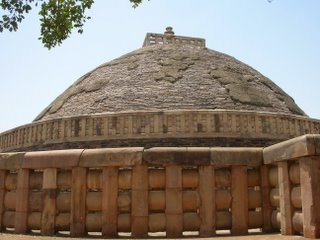
There is actually not very much to the town apart from the Stupa complex and the museum. Curiously, the place had no significance in Buddhist history or lore. There was only its location to recommend it, on a hill about 90 m high. It must have been the serenity of the outlook that attracted Emperor Ashoka all those centuries ago. He’d married the daughter of a merchant from Vidisha, and newly fired with the zeal of Buddhism. Opportunity met location and so this pilgrimage town was born.

Remember how I said you find Sanchi mentioned under Buddhism and Ashoka? That’s not all. It’s also mentioned quite a bit under the Sungas, the Satavahanas, the Guptas and King Harshavardhana. What’s the deal, you ask? What makes it so remarkable? Here it is: Sanchi is unique because it not only has the most perfect and well preserved stupas, but is a record, nay a microcosm of Buddhist art for a period of thirteen hundred years (3rd century BC–12th century AD); in fact, the entire period of Buddhism’s presence in India. That’s why.

The original mud stupa and pillar by Ashoka have been added to by ruler after consequent ruler with Buddhist leanings, till the religion subsided in the 13th century. Sanchi is a splendid gilded masterpiece that each succeeding generation of Buddhists has embellished with a coat of devotion. The entire site now comprises about 50 structures in all – pillars, toranas, temples and monasteries.

My first view of the stupa brought on a feeling of déjà vu. After all, I must have seen a few hundred pictures. There is something to be said for touching however; the real thing, your mind tells you, this is it. After I took in the larger picture, it was time to look at the details.
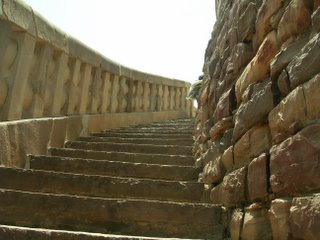
Our guide took us around, drawing our attention to panels that depicted events in the life of the Sakhyamuni. He was, I found later, not particularly accurate with his facts, but quite adept at building atmosphere. Not that the site needs it. The complex is a serene place, the clean lines of the structures contrasting with the detailed work on the toranas. It is clearly a place of worship and rather conducive to contemplation. A circumambulation of course was called for and I did it, touching the stones, aware that these were old, old beings, individual pieces now part of a greater whole.

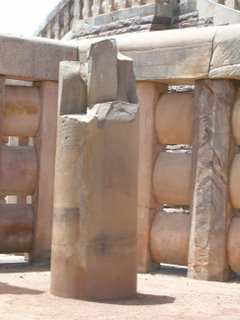
We made our way around to the southern gate to the Ashokan pillar, or rather what remains of it. A magnificent fragment of chunar sandstone, its most remarkable feature apparently is its fine polish. It is commended specially, my guidebook told me, for its ‘aesthetic proportions and exquisite structural balance’. It was a sad sight. What must have been a towering presence has been destroyed, and left in four pieces. The base of the pillar is in place, two huge chunks lie in a small shed nearby and the head – the familiar four lions – is placed in a museum nearby. The story goes that a local zamindar cut down the pillar to use it as a sugarcane press. That might be a piece of romantic nonsense, but clearly the pillar has been cut, painstakingly hacked away. My heart burned at such wanton destruction.
At the museum, the four lions occupy a place of pride. After having seen innumerable pictures, to be in the presence the real thing, to actually be able to lean over and pat them gave me a jolt. Incidentally the Sanchi lions are not the ones on the Indian emblem. That was drawn from a similar pillar at Sarnath; the lions are common to both but the one at Sarnath includes an additional dharmachakra, the famous wheel.

The museum is a geek’s delight. Lots of detailed pictures and information about its discovery and restoration. It nicely rounded off the Sanchi experience for me and I was rather pleased with it on the whole.

All this time travel makes one weary though, and I was quite happy to return to Bhopal for some R & R. Just to walk along the lake road, buy some seasoned fruit salad and choose a bench. Sitting there, watching the stars come out, enjoying the breeze in my hair… not a bad place to contemplate what a city of contrasts Bhopal is.

It has been called the City of Lakes, the City of Nawabs. The Bhopal Gas Tragedy in 1984 devastated the lives of thousands and it also smirched the city’s image. Bhopal, in the vague imaginings of the multitude is a grimy, and indeed, grim place. Naturally the city retains vestiges of the calamity; in spite of it all though, Bhopal is a beautiful city. One of those charming places where history oozes from unexpected corners, where the modern jostles for space with the old.

Bhopal has been ruled by a long line of Nawabs, many of them women. It struck me as I wandered its streets and the chowk, that while history books reel off the dozen or so names, there is something else about seeing for yourself the impact a noble dynasty can leave on a place. The Nawabs are gone but the signs of their influence is everywhere – in the names of streets, schools and colleges, hospitals, mosques and beautiful buildings, in the two lovely lakes that Bhopal buzzes around.

Bhopal’s history spills into its environs as well. Since I’d set the tone with Sanchi, I considered visiting other places of historical interest within easy radius of the city. One spot in particular – a mere 11 km off Bhopal – tells of humble beginnings. Islamnagar was the first home of the Nawabs that later ruled the city. Afghan Dost Mohammed Khan first established his capital here with a couple of small forts and palaces.
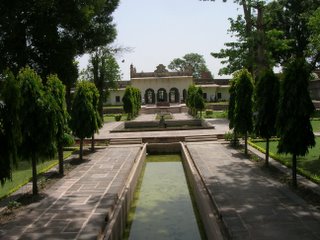
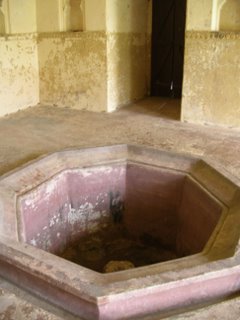
We bowled into the ramparts through tall narrow wooden gates. There are two mahals in Islamnagar, Chaman Mahal with its well laid out gardens and the two-storied Rani Mahal. Both wear a synthesis of Hindu and Islamic decorative art, with columns lavishly embellished with floral motifs. I was charmed by a small hamaam at Chaman Mahal, a smallish sauna-bath. I imagined a bearded hulk of a Pathan lounging in it, hot water steaming from his skin. Chaman Mahal doesn’t have too many rooms, but the point of it, I suppose, was the beautiful outlook – one to the gardens and one from the balcony over the surrounding woods.
The Rani Mahal has a lot more chambers and a surprising lack of windows or ventilation. On the other hand, it lead into a central courtyard with plenty of trees and shade, so perhaps it didn’t matter.

A small canteen advertised itself and I went hopefully to the counter. However, there was no coffee or tea to be had, so I settled for a tetra pack of fruit juice and proceeded to small circular room with many photos and memorabilia, plaques tracing lineages and family trees. Of particular interest: a picture of the lovely Nawab Begum Safida Sultan. Who do you think? The lady who married the Nawab of Pataudi, Tiger Pataudi’s mother!

Islamnagar exhausts its secrets in a mere morning and I had time to visit Udaygiri, to see the caves there. This is a rocky hillock with several caves that contain some rich sculptures from the Gupta era. Some really fine work here, with all the vitality and vigour experts say typifies art from that period. There were carvings of Vishnu, Durga and Ganesha… and a particularly vivid version of Varaha – the avatar of Vishnu that rescued Bhoomi, the Mother Earth from the depths of the ocean. I was delighted with an unusual Shivlinga that had the face emerging from the linga. There was even a sculpture of Karthikeya, which is rather unusual considering the deity is mostly worshipped south of the Vindhyas. Also noteworthy is a slightly defaced image of Vishnu reclining on the Seshanag, a remarkably well executed piece, with stylised oceanic waves carved all around.

I stood in one cave with an intricately carved floral motif on the roof. An inscription traces its creation to the period of Chandragupta II, who is supposed to have actually visited Udaygiri… standing across the centuries perhaps in the very spot I stood now!

Eager for an energetic trek, I traced a path up the hill and arrived slightly out of breath to a wonderful view of Vidisha. I’d visited three historic sites with Buddhist, Islamic and Hindu influences – all within a 50 km radius. Not a great distance across space, quite a leap across time.