Sunday, September 24, 2006

Talk of the Devil

The Devil Wears Prada, yesterday. Went expecting a fluff movie and well, it was kinda, but what glorious fluff!

The Marauder posts about it here, and as always speaks for me. It was such brilliant fun, the movie – the clothes, the shoes... every frame, in fact. Two very absorbing hours that steep you in the world of fashion – so completely in fact, that I stepped out of the movie's New York into real-time Hyderabad, slightly taken aback at the sight of ordinary dhoti-clad people riding scooters.

Meryl Streep as Miranda Priestly – masterly. That soft monotone, those little flickers of the eyelids. She attracted and repelled, inspired horror and admiration all at once.

Fashion, I think, is one of those things you either get or not – this film does, of course. It understands what the deal is and conveys quite nicely the all consuming focus so typical of its acolytes.

We were discussing this rather excitedly yesterday and my mother came out with something profound: of all the things we do – things we human beings do to occupy our time on earth – the two industries that make most sense are entertainment and fashion.

Almost everything we do is against the flow of life. Medicine cures, halts/delays death; developmentalists try desperately to improve affairs, managers manage other people, organise things... everything seeks to improve, change, alter. There is no genuine belief in transience or the natural rhythm of things, or we wouldn’t take ourselves so seriously.

Fashion and entertainment though are in line with the way things are, go with the flow of life – they have no utility, they are frivolous, and they also have no pretensions of doing anything other than helping you pass your time more pleasantly than you might otherwise have. They are about adornment, embellishment… and inherently rather profound in their non-seriousness. They are very much about the now, the just now.

Heh, I say this now and then, but today you must please imagine Streep’s gentle voice, cool and dismissive: That is all.

Tuesday, September 19, 2006

Rain

Rained all of yesterday. And today. No sign of the sun in two days.

The clothes won't dry, the damp leaves its smell, everything is wet and yucky. But the leaves look green and they seem to like this incessant drip. Droplets hang poetically from every bough and I have been taking mental SLR pictures all morning, playing with focus and macro frames.

Cabin fever threatens but we need the groundwater. Nothing to do but put on toe socks, a warm jacket, place myself by the window and blog.

Saturday, September 16, 2006

Side effects: Headache, nausea

Pyar ke side effects today. Dragged along by sister who thought the casting of Mallika Sherawat with Rahul Bose interesting. Also wanted to see it before Deepa Gahlot had her say Sunday morning. Not that we tend to take her word on what movies we must watch – oh no, for this is the lady who doesn’t see a movie but to see its faults, a film critic who does not want to like films. This is the person whose tastes were too fine for Dil Chahta Hai and who, when required to critique Lagaan, presumably found herself at a loss, but staunchly went ahead and criticised its budget instead.
Still, she makes valid points on good days, and if she were to come down too harshly on this small-time multiplexy movie, our flickering interest might die.

Oh would that it had! Kaash, kaash! I will spare you your money, effort and time – the phillum is bheja pakaoo. Filed under comedy and romance, it is neither.

Storyline is simple: couple seeing each other for three years. Girl wants to marry, man not sure. The theme is surely a decade old, maybe more. What woman wants to marry a reluctant man these days? None of the characters manage to convince you, or for that matter, each other.

Five minutes into the film, Sherawat’s character snatches the remote from her boyfriend who’s watching an India cricket match, switches off the TV, so she can discuss “us” and propose marriage. Such are the stereotypes we are dealing with: insensitive women and boorish men. Bah! Bose’s character hems and haws, when of course he should have frogmarched her to the door and put her outside, and then we’d be done pretty quickly.

Instead, on and on it goes for two and a half hours till you’re heartily sick of the whole thing. The jokes which are only mildly amusing to begin with, pall quickly. Non actor Rahul Bose looks tired for most of it, bags under eyes and red rimmed. Mallika Sherawat looks nice and is the best of the lot, given the lack of brief from the director.

That is all.

Tuesday, September 12, 2006

The other twin

I've been meaning to put this up forever. I wrote this piece on my hometown Secunderabad for India Today Travel Plus and it was carried in the August 2006 issue.

I'd have liked to put up more pictures but I've had the most appalling luck with them - my camera card ran out of space, I shifted computers and the few pictures I had are inaccessible, and when I got a friend send me some, they wouldn't open. And now, Footloozilla, thanks for sending 'em again but the Kodak ones are tiny. I give up.

++++++

One’s destination is never a place, but a new way of seeing things.
– Henry Miller


Writing a travel piece about a place you’ve lived in for more than two decades feels odd. After all, this is where you always travel from, and very seldom to. This is home, where there is security but not the sharpening of senses that comes with new places. My views of my hometown Secunderabad are deadened by years of familiarity; sometimes I see only what I want to, at others, I indulge in a glut of nostalgia for a street remarkable for no other reason than it was last visited more than ten years ago. A ‘regular’ travel piece then poses a bit of a challenge: what to put in, and what to leave out?

A chance to look in from the outside however came by this June, when Secunderabad celebrated its 200th birthday. Celebrations were lined up, hoardings put up and pamphlets given out and we citizens shook out of our slumberous lives and looked at our city with new eyes, astonished by the number of monuments it seemed to have – some tucked away on sylvan roads never traveled, some in bustling hubs, passed by everyday for years.

Secunderabad has always been shadowed by its twin, Hyderabad. The four minars dominate the mental landscape along with old markets, old buildings and the famed nawabi culture. Biryani, they will tell you, and khubani ka meetha. Strong spices and the fragrance of ghee fight a riot of colours for dominance of your senses. It has been easy, all too easy to be dazzled and miss completely the quieter, subtler taste of Secunderabad. If Hyderabad was the seat of the Nizams, Secunderabad was brought into existence to solidify British military presence. If Hyderabad is nawabi, Secunderabad is distinctly angrezi. Hyderabad overpowers, but Secunderabad leaves its mark slowly, more insidiously.

They’re called twin cities, but Hyderabad and Secunderabad are more properly siblings: Secunderabad has 200 years to Hyderabad’s 400. Secunderabad, it must be acknowledged, was an afterthought, an appendage. What was a tented city that housed British troops 10 miles from Hyderabad was named and given an identity. That military presence grew and left behind a heritage as distinct as Hyderabad’s.

Secunderabad’s Cantonment was where it all was two centuries ago. Intent on recreating home wherever they went, the British carved out the city on luxurious lines. The barracks, buildings, stables, churches and homes were spaced out: characteristically single-storied, low-slung bungalows standing in the middle of seemingly endless wooded lands. The view from any sufficiently high building will tell you the legacy holds on. The cantonment area is easily marked by its verdant cover, while concrete high-rises dot the rest of the landscape.

Several of Secunderabad’s monuments are linked to its military past. Take the celebrated Secunderabad Club, for instance. Used as a staging area for coaches and buggies, it was where the Resident would break off from his 30 km journey from Hyderabad, refresh himself with a drink or two before moving on to the Residency in Alwal. It became a favoured watering hole for military officers, offering games, refreshment, and when the ladies came, dances and revelry. The Secunderabad Club is still the ultimate embodiment of the good life in the twin cities. The military culture gives way to the social and waiting lists for new memberships can trail into 15 years, and are devoutly sought after.

For a true glimpse of military life, however, you must visit Trimulgherry Fort. Naturally there’s an interesting story attached. This was where British troops dug moats and isolated themselves during the disturbances of the revolt in 1857. What was a temporary camp was made a fort in 1867, with outer walls surrounded by a moat almost three miles in circumference. Once sprinkled with barracks, arsenals, stables, mews, mess houses and military offices, the place is now a military hospital.

There is another place that has many whispered stories to tell: the Military Reformatory in Trimulgherry. Built on the lines of Windsor Castle in white stone, this heritage building that sends shivers down the spines of the more sensitive. Seventy-five bare, whitewashed cells with small windows tell you wordlessly what confinement can mean. Broad stairs become narrow and steeper as you climb the next level. A central room with spikes on the floor must give you some inkling of what’s to come. The steps leading upstairs are narrower still, more treacherous… designed in fact to be inconsiderate. You know then that you are retracing the steps of the 500 men who met their death from the gallows here. The pulleys hang high and the ropes lie limp but they’re ominous. A narrow rectangle aperture reveals the spikes below. Even further up is the roof, which tells you why this building is called ‘the Ironic Crown of Secunderabad’ – a round tower with crenellations rises tall out of the rocky ground, imperious and crown-like, promising sure punishment for treachery and insubordination.

Secunderabad has even had a Nobel-winning discovery made in its limits at what is now called the Sir Ronald Ross Institute of Parasitology. This building in Begumpet is about 120 years old, and was first a hospital for the 19th Madras Infantry. Ronald Ross, a Regimental Medical Officer for local troops also conducted research on his own time, walking along the Hussain Sagar every evening, collecting mosquitoes to examine. Ross solved his riddle of malaria transmission finally on August 20 1897.

+++++

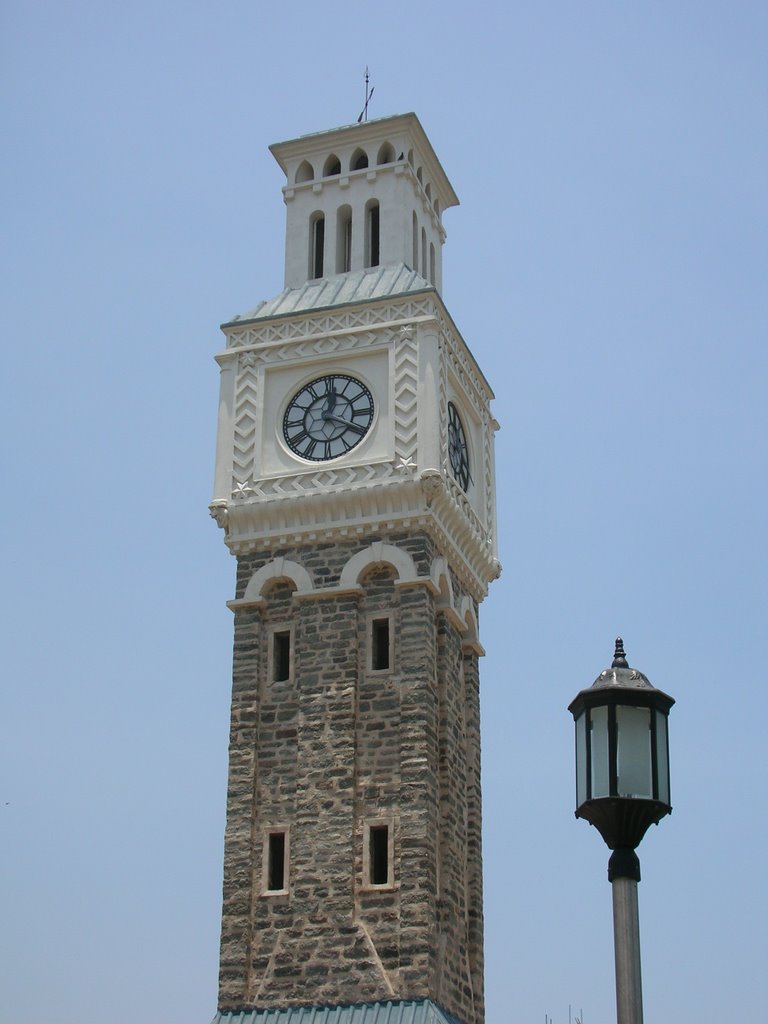
Old churches and bell towers abound in Secunderabad. Remnants of an older era, they live side by side with newer erections. This isn’t a city that dwells on its past, not even as much as it should, but still, during road widening, the old places are left untouched as much as possible, creating bottlenecks but suffered nevertheless.

In character, Secunderabad is more cosmopolitan than its twin. It receives outsiders from the southern states, houses a large Anglo-Indian population, and a significant number of Parsis. Secunderabad also has a clutch of Christian missionary schools, which till a decade or so ago were the only recourse for parents looking to educate their children well. Hyderabadi urdu is spoken here but not quite in the same way it is across the Hussain Sagar.

Modern Secunderabad is a laid back place. Not big on nightlife, but fond of its movies. In these days of multiplexes, Sangeet Cinema on SD Road is holding valiantly on, still dispensing its famous vegetable sandwiches and thronged by Secunderabadis who’re driven there as much by loyalty as convenience.

These people also love to shop. If the markets around Charminar feed life there, James Street is the hub of this side of town. The narrow labyrinthine roads of General Bazaar are legendary for getting lost in, but one thorough chakker will yield everything from gardening spades to fancy buttons. A little up the street, near Park Lane, is a slightly different market, where it isn’t at all unusual to see people leaving computer hardware shops laden with keyboards and assorted wires, or tottering under the weight of newly acquired computer systems and monitors. Secunderabadis are very fond of their chaats. Roadside stalls are ubiquitous but you must eat from chaatwallahs near the James Street police station. Bhel puri or ragda washed down with pani puri will do very well.

Secunderabad doesn’t really crave a separate identity and doesn’t fuss about being the lesser twin: the benign pace simply doesn’t call for a more vigorous stance. With not a single jingo in the lot, people are quite happy to called Hyderabadi. Still, when you live here, you know. You’re a Hyderabadi from Secunderabad and that’s a different thing.

Monday, August 28, 2006

Pokes head out of burrow

Startled to receive condolences and RIPs for this blog. Only surfaced to say, not so gone as all that. Hibernating merely, be back.

Tuesday, July 04, 2006

promises, promises

Awww, my wee li'l world-cup-orphan bloggy... not much longer, buttercup, mommy'll be back to look after you soon.

Friday, June 23, 2006

Yay

Travel website Oktatabyebye.com ran a contest recently – the application process was simple and I shot off my entry, just like that, chumma. The prize was Rs 50000 with 15 days and 7 destinations to spend it on. Turns out they meant it after all, because I’ve been shortlisted. *Jig*

There’s a profile of moi up here. Go see.

Update:
The winner was announced yesterday: Apurv Pandit. I met several of the contestants on Saturday in Mumbai and it was the most fun. We were rather tempted to pick a route and take off en masse.
Apurv is an engineering chappie-turned-writer, and is a dedicated traveller. He has visited nearly every major tiger santuary in the country and edits pagalguy.com. Cool guy.
Congrats, Apurv! We'll be tracking you, Tiger Tracker.

Monday, June 12, 2006

Splendid Secunderabad

Secunderabad has been celebrating like mad this past week. 200 years of existence and all. Almost everyone has succumbed to the ‘apna shahar, manaooru’ sentiment and attended at least a concert or an army display or something.

The Vyas involvement extended to:

1) Concert by Karunya and Hemachandra, former being runner up in Indian Idol II and the latter a close finisher in the Sa re ga ma pa Challenge 2005 contest. Both chaps sing brilliantly and they’re cousins, what’s more, so we went really hoping to hear them sing together.
Summary: Karunya was seriously good and quite people-savvy – constant banter, new songs and likesuch. Hemu was disappointing – sang three songs, none of them Telugu, which didn’t go down well with the audience. Still, he apparently dashed in and out just for the concert, so perhaps he simply wasn’t as prepared.

2) Heritage tour of Secunderabad, which was a revelation. I had no idea we had so many monuments. Three churches, one mosque, one Parsi dharmashala, two hospitals and a jail in one morning.

3) Splendid Secunderabad Run, which gave me a headache that hasn’t fully gone.
Please allow me to rant here about celebrity latecomers in general and Mr Megastar Chiranjeevi in particular. First, it is not being from Secunderabad – why call it? Second, run was scheduled at 7.00, so people gathered at 6.30. Megastar not arriveth. Organisers show dismal lack of consideration for 10,000-odd people gathered and wait for one man. Some enthu runners set off and were hauled back so they could be flagged off. So we simply flagged while we waited. Man finally shows at almost 8.00, makes matters worse by talking for a goodish time. What was a benign sun had by now turned a little ferocious.

Flag-off happened and chaos ensued. Apparently, the organisers had their finger on the pulse of the public after all: many morons are in fact interested only in the Megastar. As runners tried to get cleanly away, hundreds moved in the opposite direction towards the podium. Groups were torn asunder and women had a rather uncomfortable time of it. The run wasn’t particularly scenic and we finished in less than an hour and went off to breakfast and Pokiri.

Regrets: missing the Hariharan concert, which turned out fabulous, as well as Pt Jasraj and co and Daler Mehndi. Still, one cannot have everything, no?

Saturday, June 10, 2006

Thoreau-ly impressed

Aasheesh Pittie writes a heart-felt piece on the purifying effects of reading Thoreau on Urban Babblers. His post fired off many thoughts/reminiscences and I’ve put them down somewhat incoherently in this post.

Being rather wordy, me, these days.

Saturday, June 03, 2006

Koi Mir bhi tha

'Mir' dariya hai, sune sher zabaani uski
Allah allah re tabiyat ki ravaani uski

In this post, I’d mentioned in passing, Mir Taqi Mir’s ghazal Patta patta boota boota, and commenter Prashant asked if I could help decode it.

I have no authority whatsoever deconstructing Urdu poetry. All I have is love for the form and a few years of listening put away. There is no Urdu in my background, no cultural well to draw from, no teachers: what I have is absorbed very much from the public space. In fact, when I started off, I struggled to find anyone at all who'd help me understand some of the material I came across, a little of which I talked about in this post.

So it felt presumptuous to try translate Mir, and perhaps, interpret him. On the other hand, I thought it would be a challenge and well, fun. So with trepidation, and an awareness that this will fall short of many standards, I’m putting up a translation of sorts of Patta patta boota boota.

This is a long ghazal with, as far as I can discover, eleven shers; there may be more. Only three or four are popular with singers and I hadn’t come across a few of these before.

Patta patta, boota boota, haal hamaaraa jaane hai,
Jaane na jaane gul hi na jaane, baagh to saaraa jaane hai

Every leaf and every shrub here knows of my state
It is the flower that is unaware, but all the bower knows

Aage us mutkabbar ke ham Khuda Khuda kiya karte hain,
Kab maujud Khuda ko woh maghrur khud-aara jaane hai

We prostrated before the arrogant one, called him ‘Khuda’
In the name of God, what does that insolent one know of Him

Aashiq saa to saada koi aur na hoga duniya mein,
Ji ke zian ko ishq mein uske apna waara jaane hai.

There is no one in the world quite as naïve as a lover
The squandering of his heart he sees as ecstasy

Chaaragari beemari-e-dil ki rasm-e-shahr-e-husn nahin,
Warna dilbar naadaan bhi is dard ka chaara jaane hai

It is not their way, to heal: these denizens of the city of love
Yet even the innocent ones know the cure to a sick heart

Mehr-o-wafa-o-lutf-o-inaayat, ek se waaqif in mein nahin,
Aur to sab kuch tanz-o-kanaya, ramz-o-ishaara jaane hai

Not one here knows of kindness, loyalty, grace or generosity
Cruelty, sarcasm, mockery and taunts, of these they know

Aashiq to murda hai hamesha ji uthta hai dekhe use,
Yaar ke aa jaane ko yakaayak umr do baara jaane hai

He is but a corpse, the lover, but see! he lives again
She has come of a sudden and it is another lease on life

Kya kya fitne sar par uske laata hai maashooq apnaa
Jis bedil betaab-o-tavaan ko ishq ka maaraa jaane hai

What disasters our lover brings down on his own head,
That restless, listless soul we had given up as lost

Tashna-e-khun hai, apna kitna ‘Mir’ bhi naadaan, talkhi-kash,
Damdaar aab-e-tegh ko uske aab-e-gawara jaane hai

Parched for blood he is, and ‘Mir’ the simpleton
Thinks the sharp edge of a blade an elixir
As I see it, the play here is on the word ‘aab’ which can mean a knife’s sharp edge as well as cool waters.

There are three other shers and they are beyond me, so what I’m going to do is just supply what the words mean by themselves and leave it to someone else to tell us what Mir meant:
Yaahi shikaar-farebi par magroor hai woh sayyad bachcha
Ta'er udte hawa men saare apni ussaara jaane hai
[Yaahi = this; shikaar = prey; farebi = deceitful; magroor = arrogant; sayyad = hunter; ussara = limitless, endless]
Rakhnon se deewaar-e-chaman ke munh ko le hai chipaa ya'ani
Un suraakhon ke tuk rahne ko sou ka nazaaraa jaane hai
[rakhna = gap; deewar-e-chaman = garden wall; suraakh = hole, aperture; sou = ?; souq?]
Lagne na de bas ho to uske gohar-e-gosh ke baale tak
Usko falak chashm-e-mai-o-khor ki teetli ka taaraa jaane hai
[gohar = pearl; gosh = ear; baale = earring; falak = sky; chashm = eye; mai = wine]
Mir at his most convoluted. An earring, a pearl, a winejar and a star in the sky - there are all these elements; and whether Mir means to see a pearl hanging from an earlobe through the spout of a winejar and perceives it as a star in the sky, or the other way round, I have no idea. I may add, after reading it a sufficient number of times, I no longer care.

That's that. Often, words in Urdu have diverse interpretations and change chameleon-like in context, so if you’re still determined to decipher all this, this dictionary might help. In fact, I’ll add it to the links on the side bar. It’s organised by pronunciation and doesn’t follow a simple-search-and-throw-up but it grows on you.

Yay, that was fun.

Wednesday, May 31, 2006

Randomness

Fanaa yesterday, which I found to be neither very good nor very bad, but best approached with very low expectations.

+++

I particularly liked the chase in the second half. Terrorist Rehan parachute-drops from a plane on to snowy slopes of Poland-as-Kashmir and skis away as the Indian army gives chase. Good-looking top shots of the monochrome silver-white landscape and a racy sequence.

+++

Rishi Kapoor seems to have carved out a niche for himself as Bollywood’s resident lush. And so he is here rarely seen without a drink in hand, being slurred and charming.
(SPOILER ALERT)
His character makes the same mistake many others on celluloid have made: that of approaching a deadly villain with gun in hand and then engaging him in conversation and worse, moving within an arm’s length of aforesaid villain with only a slack hold on aforementioned gun. His daughter makes the very same mistake ten minutes later, confirming that lack of good sense runs in the family.

+++

Subhan Allah sounds a bit like the notes in Desert Rose, nai? whatever… it’s pleasant enough.

Sunday, May 28, 2006

Pick one

Choice of you shuts up that peacock-fan
The future was, in which temptingly spread
All that elaborative nature can.
Matchless potential! But unlimited
Only so long as I elected nothing;
Simply to choose stopped all ways up but one,
And sent the tease-birds from the bushes flapping,
No future now. I and you, alone.

So for your face I have exchanged all faces,
For your few properties bargained the brisk
Baggage, the mask-and-magic-man’s regalia.
Now you become my boredom and my failure,
Another way of suffering, a risk,
A heavier-than-air hypostasis.

-Philip Larkin

Only so long as I elected nothing.