Monday, November 26, 2012

Request


kaShTadallirali utkruShTadallirali eShTadaru matigeTTu irali
krushNa kruShNa endu shishTaru pELuva ashTAkshara mahAmantrada nAmada
nArAyaNa ninna nAmada smaraNeya sArAmrutavu enna nAligege barali...
-Purandara Dasa

Whether I be in trouble, or in a perfect state, be my mind ever so disordered,
Let me utter 'Krishna, Krishna', the eight-syllabled mahamantra that the learned chant
Narayana, let my tongue taste the nectar that the remembrance of your name brings

Thursday, November 15, 2012

Creature Comforts

Another deadline stares me in the face and since I cannot yet meet its eyes, my attention darts here and there. Let me put up this story of a river (and continent) I loved very much.

_________

Creature Comforts

There is something about great rivers, and there is something particularly special about the Zambezi. Wide, life-giving, embracing but also ferocious, and imperious in that manner of sweeping all before it. It is impossible to know – or love – a river such as this too well. And certainly not on the basis of a two-day acquaintance. But then, as lovers everywhere know, it depends on the two days.

Oddly, what I found most impressive was the fact that Zambezi, which traverses a distance of 3,540 km, and crosses seven countries to empty into the Indian Ocean, is only the fourth-longest river in Africa. It duly takes its place after Nile, Zaire and Niger – a little comparative study that brought home to me, firsthand, the magnitude of this land. I had read of colonial travellers’ term for the vast swathes of this continent. MMBA, they had called it, in part awe, part rueful frustration – Miles and Miles of Bloody Africa. I could see it now.

Our headquarters in Livingstone, Zambia, was the Royal Livingstone, a hotel located at a particularly well appointed spot on the banks, with a view of the Zambezi just before it hurtles down a chasm to form the magnificent Victoria Falls. The hotel’s lobby is designed to make most of this vantage: you walk in and gaze not upon the room (which is tasteful) but through the other archway which frames the blue-grey expanse of the water. Everywhere, in the dining areas, the charming rooms with their open verandas, the architecture employs an intelligent, pitch-perfect permeability between indoor and outdoor spaces.


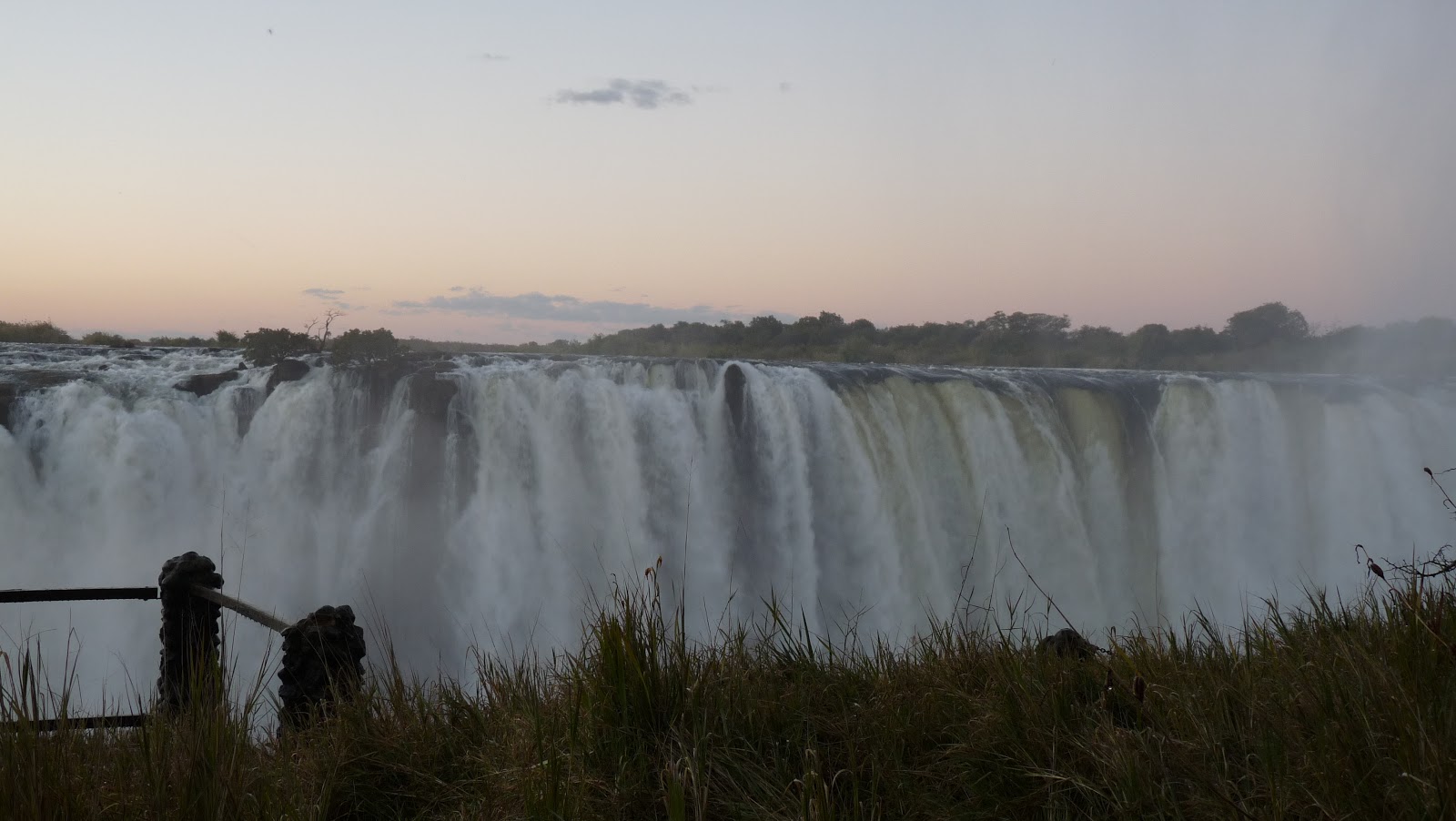
Our very first item on the sightseeing list was, naturally, the Victoria Falls, ‘the largest sheet of falling water’ on the planet. Actually we’d been seeing it for miles. On the flight in, the flight attendant’s plummy tones had directed us to look out of our windows to the mist rising off ‘Vic Falls.’ Then as we drove from the airport with the river a constant presence on our right, we pulled up to see a soaring froth in the distance and a brilliant rainbow caught in its snare. From the hotel’s deck, again, in the distance, the spray. It was, without question, the centrepiece.

We moved closer now and the sound of cascading water deafened us. Mosi-oa-tunya, the Makololo people call it: ‘the smoke that thunders’. It does indeed. As we approached the eastern cataract, Francis, our guide, pointed into the water. A black rotund sleekness surfaced slowly - a young hippo marooned by the swirling currents, not strong enough to wade to the other side, clinging to the less turbulent shallows by the reeds. He could be there for days, we were told.

We donned raingear, protected our cameras and lenses in plastic covers and started walking to the other side of the fissure. And around a corner, our first frontal view of the waterfall. Through shrubbery at first and then, as we picked our way along the edge of the gorge, getting wetter and wetter from the needle spray, the whole amazing expanse of it. It is a breathtaking sight, one neither our cameras nor our exclamations could do justice to. Let’s put it this way: it’s bigger than us.


We went the next morning on a quintessential African activity – a game drive. The Mosi-o-tunya National Park is a small one (66sq km) but it gave us a full morning’s sightings. How astonishing it is to set out to see fauna in Africa – there is no lurking, hiding; no strained glimpses through shaded shrubbery… there’re all out there, in the open, crossing your path with impunity. So we saw herds of Impala, Bushback antelope, Wildebeest, Zebra posing this way and that. A Southern Red-billed Hornbill honoured us with multiple sightings, a warthog ambled our way and we encountered a large troop of baboons. I brought my binoculars out to get a good look at a Saddle-billed stork and the strange Hamerkop bird. We came then to a completely denuded tree on which perched an appropriately sinister gathering: a venue of White-backed vultures. We pulled up again at another point – majestic elephants, a small herd of five, would have right of way. Of course.

We didn’t see any big cats but I was delighted enough with my first sighting of a giraffe. What a strange looking animal it is. Put together like an assortment of other creatures and that bizarre neck with a touch of fur all the way down! Our specimen nibbled placidly at the upper leaves, his marbled skin pattern catching the light beautifully. Just like they said in the nature documentaries.
Next, I had a choice of activities. The first, to go by boat to Livingstone Island, to the spot where the explorer David Livingstone first discovered the falls in 1855. I was tempted but I opted for the other item on offer: to jump off the Victoria Falls Bridge.

After the falls, the Zambezi gushes into this narrow scenic gorge which has this historic bridge across it – a no-man’s land that connects Zambia with Zimbabwe. I was excited about this bungee jump. My very first, and so pleasing to do such a celebrated one!  As we drew to the bridge, however, the anticipation turned into dry-mouthed dread. I looked down and saw… way, way down… the teal blue waters swirl and churn. Around me jumpers were getting into harness and taking off to plummet 111m towards the river. My turn came. I was having my feet bound with padding and the bungee cord, and was asked to move, hopping, to the edge… the very edge of the platform. I twitched nervously but with the jump master blocking my passage backwards, there was no way but forward – into thin air.

I didn’t… couldn’t… soar outwards like I was advised to. Instead I fell with a scream like dead weight. I went first, the body followed, the stomach joined us several minutes later. It was truly beautiful… suspended upside down, being tossed up and down in the ravine, twirling around to see a fully circular rainbow from the spray.

Yet another view of the falls was afforded me the next day, when I went up in a micro light. It’s a vehicle too flimsy to be taken seriously but miraculously, it worked. There I was, insulated like an astronaut against the morning chill, looking down this way and that. What seemed like grey boulders were strewn about abundantly – elephants! A vein of silver-blue picked out the Zambezi’s course and soon we were motoring –inevitably –towards the falls. The small plane tilted into the spray, which rises on average to about half a kilometre in the air. The cataracts sprawled across 1.7 km, thundering down over 100m. I saw the bridge I had leaped off the previous day and marvelled anew at my own daring.

It was a good way to say goodbye, and now South Africa beckoned. Rather, more specifically, Sun City. A three-hour, cramping drive from Johannesburg deposited us at the entrance of the Palace of the Lost City – which is an experience that is at once dazzling and bemusing. Opulence meets quirkiness in this wild Xanadu-like hotel – sweeping halls, tiled mosaic on the floor, ceiling… everywhere. Spires, domes, columns, sculptures, tapestries, genuine animal skin upholstery… everything at once.

Sun City is a huge hit with Indian travellers who have made their presence felt, one way or the other. And we very nearly added to it. Bart, a gametracker at the Pilanesberg Game Reserve, was scheduled to meet us at 3.00 that afternoon. But we’d had a rough day, worsened by a small accident on the Segway and consequently, it was an hour later that we trooped to the game vehicle. Our guide was furious. After informing us that punctuality was a trait much prized in South Africa, he laid down the Indian-tourist-specific rules: “This vehicle stops when I want it to, moves when I decide. So don’t ‘chalo, chalo’ me. There is no ‘chalo, chalo.’” Oops!

But the afternoon improved. Sighting a lioness in the distance as we had only just entered the park set the seal: it was going to be a good day. The Pilanesberg reserve is set in the crater of a long extinct volcano: plains fringed by mountains. The habitat is a transition between the Kalahari and the Lowveld, and so benefits from an overlap of species. To the eye, it was a vivid, dramatic panorama that changed moods every twenty minutes as the afternoon went by.

In the distance, we spied a bulky grey figure snoozing. White rhinoceros. Two impressive horns, small flappy ears and over 3,500 kg of mostly muscle. Antelopes we saw an abundance of: the smallish Steenbok and the handsome Kudu. Bart thawed towards us – clearly, tourists as lucky as we appeared to be couldn’t be that bad.

The light had started to slant when suddenly he stepped on the brakes with an excited yelp and pointed.  A leopard high up in a tree, resting delicately and yet, quite comfortably on a mass of foliage. We found the spot with the best view and settled, willing to wait as long as the leopard did. The lone tree and the panther silhouetted against the gathering dusk – it was a moment of unbelievable rightness. A few minutes later, the cat tired of his perch and clambered down, carefully negotiating his way down, clasping the trunk as he backed onto the ground. And then with a last look at us, he leapt across a small stream and melted away into the tall grass.

Elated with our encounter, we headed back to the gates. And stopped again. A brown hyena minced along the side of the road, glassy eyes staring back at our searchlights. It crossed the road and we saw it gone before we set off again. A little further, a traffic jam. Game vehicles had stopped in the middle of the road and a hushed silence – one that indicates a sighting of no ordinary significance – prevailed. Soon the object of their attention became apparent to us. Quite by the road, three lionesses at play. Caught in a pool of cross-lighting from the various game vehicles, the sisters ambled, swiped, nuzzled and gambolled. After five minutes, or perhaps ten, they walked slowly away till the darkness enveloped them. Now it seemed indeed that a visit to Africa was complete.

______
This was published in Outlook Traveller, October 2012. The link is here. 

Tuesday, November 13, 2012

Diya jalao, jagmag jagmag...

Happy Deepavali, all!

Just back from a 6-day assignment. I wish I'd had a day to prepare for the festival, but I landed late last night and haven't enough go to make a celebration of it.

The morning meal was regular, the sweets are bought not homemade, the puja was delayed - I feel the festival but I cannot make it all-festive for my home. This bothers me. Some unnamed obligation to do the right thing, sadness that I don't make too much of an effort, that the old ways fall away to the modern insistence of not being hassled, of doing the easy thing all the time. The evening's session will be better, I promise myself.

But I have something to console myself with. As I made my way back home yesterday, my hopping flight stopped in Chennai. And what a wonderful sight it was! The city was lit with festoons of light and as the plane lingered in the low skies, pyrotechnics in various colours and types, one after the other. Street after street went up in celebration and for once, the birds' eye view wasn't of a metropolis peopled with anonymous denizens, probably grimly going about their business of living - these were fellow human beings, kin of sorts, joyously marking the onset of winter. Each of those rockets had someone below -- a man, woman or child -- who had enthusiastically let it into the sky, and was now looking up in expectation, his or her face lit by the colourful sparks they had unleashed. It was lovely. What luck to be in the air on the eve of Diwali.

Sunday, November 04, 2012

Mere hanjroon de toofan*

I dusted off an old, much-loved music album today with songs by Anup Jalota. And re-found this sher with a very short behr:

baithe baithe rone ki,
rut hai paagal hone ki

बैठे बैठे रोने की
रुत है पागल होने की 


And it seemed to fit my mood (and so goes on the header). You see, somehow this November (1, 2) is here again. It has always been a vivid month for me. Everything darkens... you begin to prize what light there is. This year, the month has begun with a piercing drizzle as well. Everything inexplicably turns a little more profound, more meaningful -- also a little melancholy. I cannot say why.

Fittingly, this ghazal has another sher that I like:

marne wala mitti ka
arthi chaandi-sone ki

मरने वाला मिट्ठी का
अर्थी चांदी सोने की

That's it! How did the shayar manage to pack so much comment into eight words? These poets, I tell you...

__________
*The blog title is from Farid's Meda ishq vi toon, in which he says, among other things, 'Mere hanjroon de toofan vi tu...': you are (also) my stormy tears.

Sunday, October 28, 2012

Moonstruck


Third post for the day.

I've said before, the moon has never been as significant to me as it has been of late. Rather, I now realise that it has always been significant but I had not noticed. 

Isn't it curious how some things never come your way and when they do, they tend to come in bunches of three - a new word, or a concept or a piece of trivia? I had never heard about the Sahasra Chandra Darsanam – it had never been done in my family – but a friend told me last year that her family was going to have a pooja and a gathering to mark her father-in-law’s turning 83 and a few months. It was to celebrate a point where he had experienced a thousand cycles of the moon in his lifetime. Then another colleague of my father's turned a 1000 moons and then my Guru mentioned it. Not that you need to have seen a thousand full moons with your eyes, he specified, knowing perhaps that many of the fools that he looks after stay hunched over their petty lives, instead of looking up at something profoundly amazing simply because it happens every month. The body apparently has its own way of experiencing the ebbs and flows of the world around it. Once it has known a thousand lunar cycles, the human system alters in a few ways, making it easier to shed your karma – or that's how I understood it.

But it is no hardship to look at the moon. And when a full moon coincides with your travels, well, sona on top of suhaaga. It happened in Zambia. (Where I was not able to take the Rainbow Walk, which takes you to the Victoria Falls by moonlight and, if you're lucky, gives you a glimpse of the Moonbow - a rainbow refracted by moonlight.) But I was happy enough to be in a lovely cabin by the expansive River Zambezi under a full moon. It was light when I sat to meditate in the lounger outside; when I came to, it had darkened to deep purply ink, the moonlight glistened off the choppy waters and it was so beautiful. I have no picture of that sadly, and I doubt any lens of mine could’ve done justice.

A month later, my incredible luck saw me in Srinagar. As the moon waxed, we saw it every day – rising from behind craggy mountain frames, as we stood about this Mughal garden and then the next as darkness fell… 


From Chashm-e-Shahi Gardens, Day 1

From Nishat Bagh, Day 2


On our third day there, we were in Gulmarg, making our way back (rather late) to the parking lot where our anxious driver awaited the posse of women he was in charge of. As we walked back, there were these views.
Strolling down the lanes of Gulmarg, Day 3


As we drove back to Srinagar, the world had turned monochrome. Only blue-black and silver seemed to exist; we turned bend after bend to a new view as the dappled woods stood bathed in moonlight. I had not seen trees throw shadows that sharp at night.

On the fourth day, we had a party on top of a houseboat. The full moon was on time, voices carried this way and that over the water, sounds of paddles sloshing, and in the distance, traffic on the road.
Full moon over Srinagar from HB Hilton on the Dal, Day 4. Pic: Nishat Fatima

You can’t hold moonbeams, of course, but now and then, you come close enough.

Andananta etha?

We were talking about Kshana kshanam yesterday - what a classic it is, how refreshing the music, the way the songs were 'taken' as they say in Tollywood-speak. And of course, Sridevi. Gamine charm, mobile face, now innocent, now sexy, now crafty, now ditzy. She carried the movie. Venkatesh rocked too, but Sridevi!
 
So as I'm feeling somewhat excessive:


...and, why the heck not!


Whachoo doin', Ramu? Kuch cheezein apne aap se bhi seekhni chahiye.

The in-between times

I had a haiku for the rains, I really did. A hauntingly beautiful one. But I procrastinated, and now the season is past. A new one advances but we are not yet in its grip. So the change of header demands not a remark on the seasons but something else.

So just like that, this funny haiku that's a study in plotting, on how to tell a story... and the importance of the villain.

shiny red apples
the painter introduces
a caterpillar

~Greg Piko

Thursday, October 04, 2012

Housekeeping

Dust lies on the shelves of this blog. The haiku hasn't been changed since the summer, the air is musty, and everywhere, cobwebs of abandoned posts.
But soon - a post on Kashmir, which I visited last month, my story on Zambia, where I travelled in July, a header change, some thoughts on the moon... much!
In the meantime, I post now because I'm running very very fast from a deadline that is upon my heels and will slay me if I don't wrestle it to the ground. Wish me luck.

Saturday, September 29, 2012

A gala time

It has been a crazy month. I was swamped by deadlines of varying levels of clinginess – it was just one thing after the other. In the middle of all this though, there was something I was determined to do – attend the Park Hyatt’s Masters of Food & Wine event. This is a series of sophisticated culinary and beverage experiences hosted at Park Hyatts across the world. Award-winning chefs, sommeliers and experts are invited – it is a celebration of food and drink.

The Park Hyatt in Hyderabad is fairly new and they were holding their first Masters of Food & Wine between 19th and 22nd September.  The Masters in this case being Spanish 2 star Michelin chef Koldo Royo, Thai chef Maitree Polboon and French cheese affineur Eric Mickael.

The whole programme sounded fascinating but work! But I managed one night off – donned a dress and took off to a five course gala dinner at the Tre-forni where Chef Koldo Royo’s offerings would be paired with wine from the house of Torres. It was a lovely experience.

Some lip smacking Sangria and fritters whet the appetite, strawberry gazpacho followed and then buttered and herbed mushroom on a bed of mashed peas. Two desserts – a convent-style coffee custard and a rice pudding flavoured with Spanish anise. The wines were fabulous too and I was taken with the dessert wine Floralis - Moscatel Oro – a sweet mouthful with tints of rose, geranium and lemon verbena.

The Spanish Ambassador, Gustavo De Aristegui, honoured the evening with his presence, and he came by to talk of wines, India, culture, Japan and Bollywood movies. Has Zindagi Na Milegi Dobara made a difference to tourism, I asked. Emphatically yes, he said, in fact the filmmakers and cast may be meeting the King of Spain to receive his appreciation.

I wish I had attended the Thai event as well. Another time.

Sunday, August 26, 2012

What I did

There were so many things I meant to blog about but there wasn’t enough time when the mood came upon me, some posts needed an elaborate gathering of thoughts and links, some needed notes to be collated.

Still, I have a few updates. I spent the first fortnight of this month in the most unusual fashion: I was at the Isha Yoga Center to volunteer. They somehow had three programs lined up with a day’s gap between each and it seemed a good idea – at the time. Had I known how demanding the stint would be, I may have had second thoughts. I had attended all these programs last year and had been struck by the wholehearted devotion of the volunteers who had served the programs. It seemed very appropriate for me to do this as well. A part of it was a desire to ‘pay it forward’, and partly, having heard so much about the experience of volunteering, to taste for myself what such giving can do to the giver.

So I landed there on pournami, offered my services, my body, mind and presence in any manner they thought fit, and came away on amavasya – a poetically arranged period. It was quite a unique experience, something that broke quite a few notions of myself that I had lived comfortably with. I no longer know for sure. An advancement, of sorts.

Woh bhi kya din the, ke har veham yakin hota tha
Ab haqeeqat nazar aaye to use kya samjhoon?

-Ahmed Nadeem Qasmi

वो भी क्या दिन थे के हर वेहम यकीं होता था
अब हक़ीक़त नज़र आये तो उसे क्या समझूं ?
-अहमद नदीम क़ासमी

Now the prospect of other interesting travel faces me – excited, happy-excited. There are things beyond our imaginings, our wildest hopes… what a good thing we don’t always get only what we thought to ask for.

Friday, July 20, 2012

Barsan laagi...

...kari kari baadariya...
umad umad ghir kaare badal, nanhi nanhi boondariyan aayi

After a long time today, I have arranged it so I listen to a monsoon raga as it rains. Nazakat and Salamat Ali Khan with Megh Malhar. I remember doing this once many many years ago. Favourite music lay in tapes in those days and I had a second generation recording of Shiv Kumar Sharma playing Megh. Side B was, if memory serves me well, Jasraj singing Dhulia Malhar.
Inspired by tales of the elements pouring down when Tansen sang his own Malhar and diyas catching flame when he sang Raag Deepak, I tried it myself. Played the recordings a couple of times back to back, sent up the rain yearnings with as much intensity as I could manage. And it rained. For hours. All day. And the next. I had no doubt at all I had caused it. There is something to be said for faith and innocence.

Sunday, July 15, 2012

Phool khile hain...

The rains are here again, everything is beautiful and our jasmines are flowering. We have four plants around the house and mercy be, they’re all putting out buds.

One of these is a particularly insane giver. Once spring arrives, it kicks gears all the way up. No holding back, no spacing out… just whooooosh. For a week or ten days, the whole creeper turns white with abundance. My mother – grateful and dismayed at this bounty – would need several pairs of helping hands to haul them in. Then she would sit and laboriously try to string as many as humanly possible into garlands.

I’ve always enjoyed gathering these flowers, which I found a bit surprising. I used to have a very low boredom threshold and surely this is boring, repetitive work? But I think now there is a meditative quality about the activity. Giving, taking, loving, thanking… a sweet transaction.

I was so pleased yesterday to have samples from all four shrubs, I took the trouble to document it. For whiteness and fragrance, I do believe our big ones could rival the mallis of Madurai.


And here, simply because the malli is the recipient of the hero’s confidences, being asked to bear witness to the woes that beset his life, this song. Also because I love Ghantasala’s extra long caress of the phrase “mounamuga unnaaaa…ra?” The song actually begins at 4.28 so jump ahead please – this was only video I found.